Rösler Oberflächentechnik GmbH

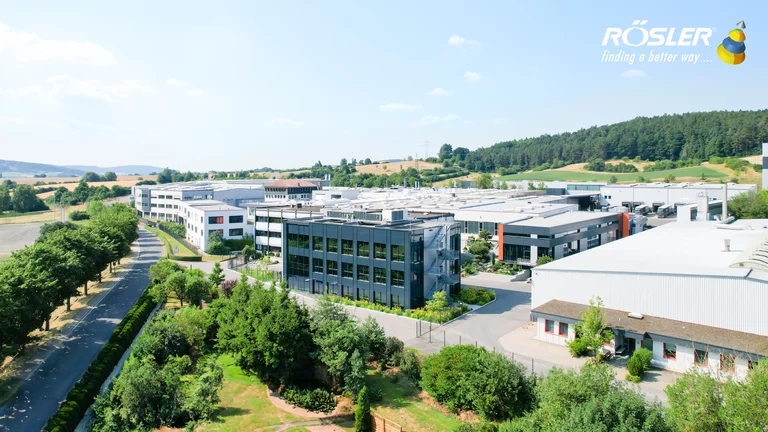
Rösler Oberflächentechnik GmbH, headquartered in Untermerzbach, Germany, is a global leader in the development and manufacture of machines, systems, and process solutions for surface finishing. With decades of experience and a global network, Rösler offers customized solutions for a wide range of industries, from automotive and aerospace to medical technology.
The company operates worldwide as a full-service provider of
vibratory finishing and blasting systems, preservation lines,
and process water treatment systems. In addition to the
systems, the process agents required for vibratory finishing
technology are developed and manufactured in-house.
Furthermore, a few years ago, the company established a central
training and continuing education center with
the introduction of the
Rösler Academy. It is a competence center for
knowledge transfer in the field of surface finishing. It
combines technical know-how with practical application and
supports both internal employees and external customers in
making processes more efficient and safer.
Since 1985, we have been your expert partner in Northern Bavaria for all applications and processing variants in the field of vibratory finishing and blasting technology.
Since 2021, in addition to our customers in northern Bavaria, we have also been serving the Saxony region in the field of vibratory finishing technology.
We provide on-site support from process planning to production launch. We work with you to optimize existing processes. The right process technologies and equipment can be determined during trials in our in-house technical centers.
Please get in touch with us: We will be happy to advise you and develop the right solution for your machining task.
Vibratory finishing technology
Vibratory finishing technology is a mechanical process for surface treatment of workpieces. It is used for deburring, edge rounding, smoothing, polishing, and cleaning of components. The process is frequently used in metal, plastic, and ceramic processing.
How it works
- Workpieces are placed in a vibratory finishing machine together with abrasive media (e.g., plastic, ceramic, or stainless steel) and, if necessary, compound (liquid for cleaning and corrosion protection).
- The relative movement between the workpiece and the abrasive media results in uniform material removal.
- Types of machines:
- Round vibrators
- Trough vibrators
- Centrifugal machines
- Continuous flow machines
- Tumble finishing machines
- Process water treatment systems (e.g., centrifuges)
Typical media
- Plastic abrasives: For gentle processing, often used with aluminum.
- Ceramic abrasives: For heavier removal.
- Stainless steel media: For polishing or pressure deburring.
Areas of application
- Automotive industry: Deburring of die-cast parts.
- Medical technology: Polishing of implants.
- Mechanical engineering: Edge rounding of milled parts.
- Jewelry industry: High-gloss polishing.
Advantages
- Processing of many parts simultaneously.
- Uniform surface quality.
- Can be combined with cleaning and drying.
Disadvantages
- Process duration longer than blasting.
- Greater space requirements for machines and media.
- Media wear and disposal.
Blasting technology
Blasting technology is a surface treatment process in which an abrasive is propelled at high speed onto the surface of a workpiece. The aim is to clean, matt, deburr or strengthen the surface.
How it works
An abrasive (e.g. glass beads, corundum, steel balls) is accelerated by compressed air or centrifugal wheels.
The kinetic energy of the blasting agent causes:
- Removal of contaminants (e.g., rust, scale)
- Matting or smoothing of the surface
- Increase in surface roughness for better adhesion (e.g., before painting)
Typical blast media
- Glass beads: For fine, even matting without material removal.
- Corundum: For aggressive cleaning and increased roughness.
- (Stainless) Steel media: For shot peening (surface hardening).
Types of processes
Compressed air blasting
- Blasting media is accelerated with compressed air.
- Flexible, for small to medium-sized workpiece
Turbine blasting
- Blasting media is accelerated mechanically.
- High performance, for large series and heavy parts.
Areas of application
- Metalworking: Deburring, matting, cleaning.
- Automotive industry: Preparation before painting.
- Aviation: Shot peening to increase fatigue strength.
- Medical technology: Surface finishing of implants.
Advantages
- Uniform surface treatment.
- Removes oxides, scale, and coatings.
- Improves adhesion for subsequent processes.
Disadvantages
- Dust generation → extraction required.
- Energy and abrasive consumption.
- Risk of material distortion in thin-walled parts.